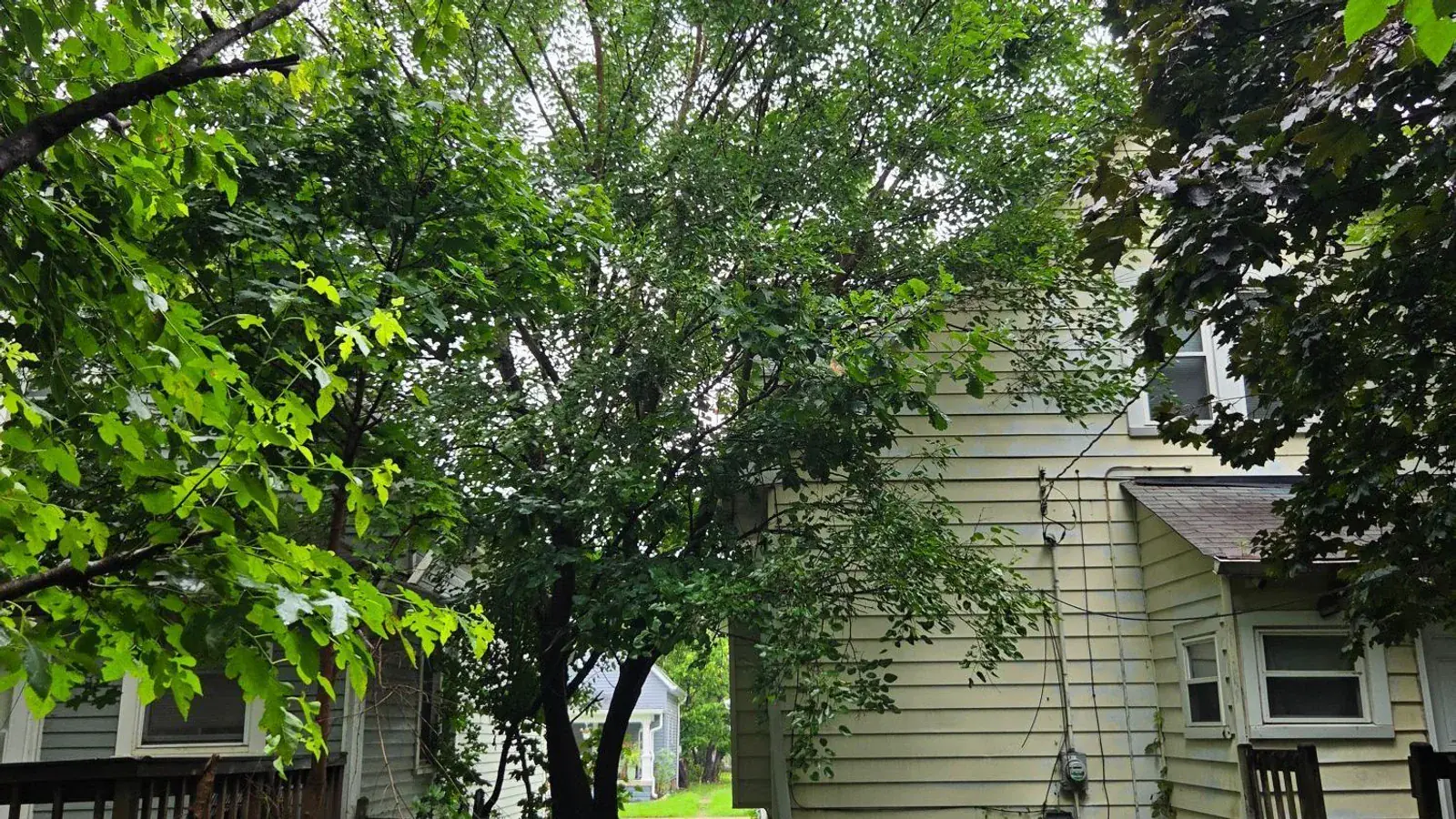
It's the question behind most of the calls we get: there's a tree, it's doing something that worries you — dropping limbs, leaning, shading the whole yard, rubbing the roof — and you want to know whether it needs to come down. The honest answer, most of the time, is no. A healthy tree with a clearance problem or some deadwood is a trimming job, and trimming costs a fraction of removal. But some trees genuinely have to go, and it helps to know what we're looking at when we say so.
Start with the trunk, because that's where the tree either is or isn't. A hollow sound when you knock on it, mushrooms or shelf fungus growing out of the base, bark falling off in sheets, a vertical crack, or a cavity you can put your arm into — any of these means the structural wood is compromised. A tree can look full and green above a rotten trunk for years, right up until the day it doesn't. If the trunk is bad, the crown doesn't matter.
Then look at the forks. Where a trunk splits into two big leaders of similar size — a co-dominant fork — look for bark pinched inward between them instead of a raised ridge. That's included bark, and it means the two halves aren't actually joined; they're leaning on each other. Silver maples and Bradford pears are the classic cases, and it's why both are so often the tree on the garage after a storm. A young tree with this can be pruned to a single leader. A big old one usually can't, and cabling only buys time.
Lean is the next thing. A tree that's always leaned and has grown that way is usually fine — trees lean toward light. A tree that has started leaning recently, or is leaning more each year, or has soil heaving or cracking on the side away from the lean, is a tree whose roots are letting go. That one comes out, and soon, because the thing it's leaning toward is usually the house.
Deadwood on its own is not a reason to remove a tree. Every mature tree carries some, and cleaning it out is routine. What matters is the proportion. If a third or more of the crown is dead, or the top of the tree has died back while the lower limbs are still leafing, the tree is in decline and you're deciding when, not whether. Ash trees in central Indiana are the obvious example: once the emerald ash borer has thinned the crown that much, the tree is finished and it gets brittle fast, so it's safer and cheaper to remove it while it can still be climbed.
Then there's the tree that's healthy but simply wrong for where it is. The cottonwood ten feet from the foundation, the silver maple whose roots have lifted the driveway twice, the pin oak planted under the service drop. You can trim these forever, and sometimes that's the right call, but at some point the maintenance costs more than the tree is giving back, and replacing it with the right species in the right spot is the better spend. We'll say so, and we'll plant the replacement.
What shouldn't push you toward removal: shade, leaf drop, a few surface roots, sap, seed pods, or a neighbor's opinion. Those are annoyances, not hazards, and most of them have a cheaper answer. Neither should a single storm-broken limb — that's a cleanup and a look at the rest of the crown, not a death sentence.
The three situations where it stops being a judgment call: a trunk that's structurally rotten, a recent and worsening lean, and a dead or mostly dead tree over something that matters. Everything else is a conversation, and it's one we're happy to have in your yard, for free, before you decide anything.
Got a tree you're not sure about? Call Lorenzo's Tree Services at (317) 353-7590. We'll walk it with you, tell you honestly whether it's a trim or a removal, and give you a written price for whichever it is.