
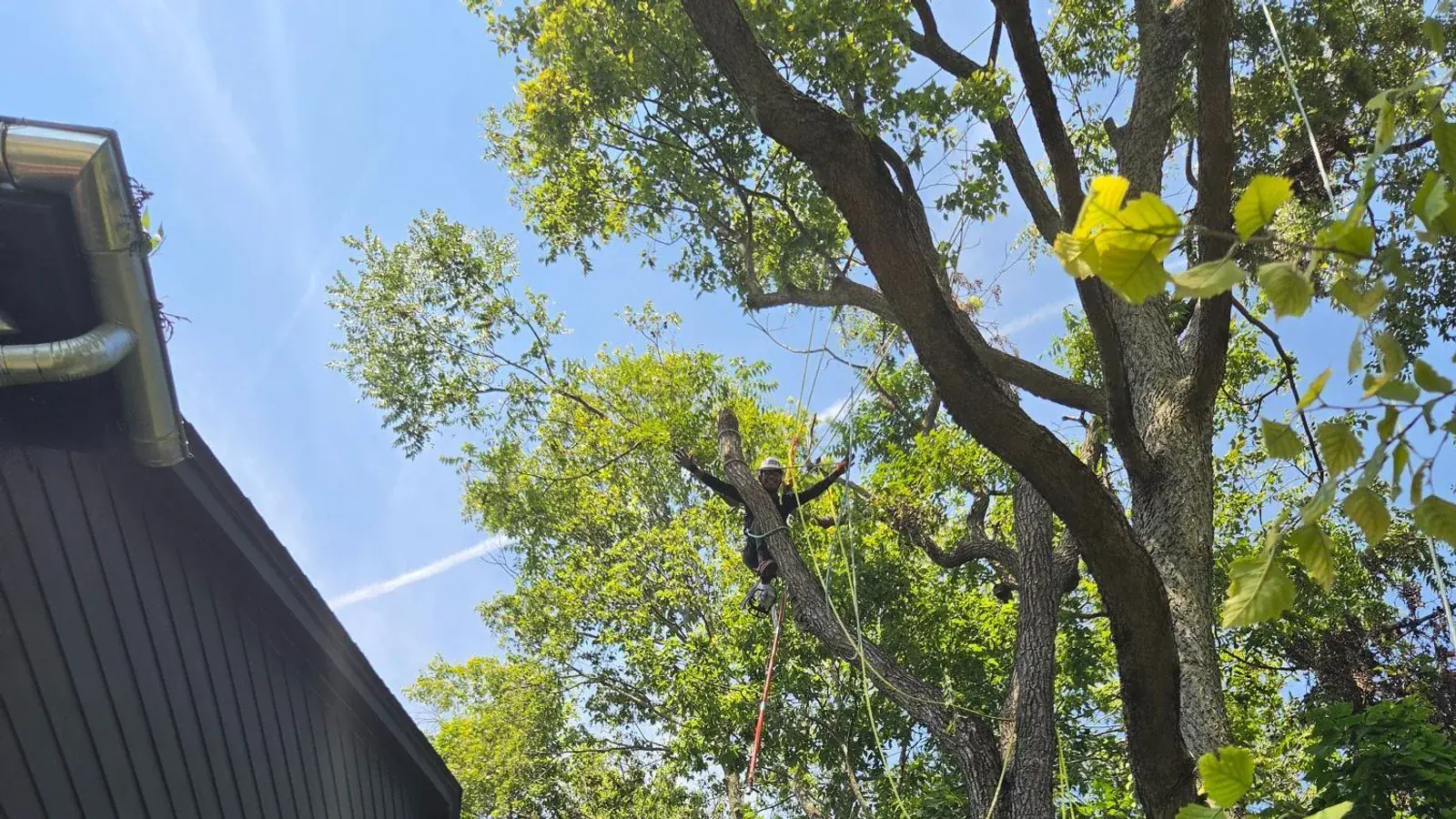
Every year, from late spring through summer, a line of storms comes across central Indiana with straight-line winds that do more tree damage than most people expect, and every year the morning after we're pulling silver maples off garages and cutting cottonwoods out of driveways from Greenfield to Zionsville. The thing worth knowing is that most of those trees were telling you they'd fail. Here's what to look for while the trees are bare and the ground is soft enough to work.
Start by walking your yard in March, before the leaves come out, and look up. Without the canopy you can see the structure of every tree: the dead limbs with no buds, the hangers — broken branches still lodged in the crown from the last storm — the cracks and cavities, and the long limbs stretched out over the roof carrying too much weight for the wood behind them. Everything you can see now disappears behind leaves in May and then reappears on your lawn in July.
Deadwood is the easiest fix and the most common failure. A dead limb has no leaves to spread the wind load and its wood gets brittle, so it snaps in gusts a live limb would ride out. Getting the deadwood out of a crown is a half-day job on most trees, and it removes the most likely thing to come through your roof.
Weight reduction is the second one. Trees grow toward light, so the limbs over the open yard — or over the house, which is open sky from the tree's point of view — get longer and heavier every year. A properly done reduction takes the end weight off those limbs without stubbing them, and it makes the difference between a limb that flexes in the wind and one that tears out at the trunk.
Then look at the forks. The narrow V-shaped fork with bark pinched into it is the weakest structure a tree can have, and in silver maples and Bradford pears it's practically standard. If the tree is young, pruning it to one leader fixes it. If it's mature, a cable can support the fork, and in some cases the tree is simply going to split one day and it's better to decide when.
Trees near the house deserve a second look at the base. Mushrooms at the root flare, soil lifting on one side, or a lean that wasn't there last year all mean the roots are compromised, and a tree with bad roots doesn't fail by dropping a limb — it fails by falling over. That's a removal, and it's better done on a calm day with a crane than after it's already on the second floor.
The morning after a storm, the order matters. First, stay away from anything touching a power line and call the utility. Second, don't cut anything under tension — a limb resting on a roof or a fence is loaded like a spring, and cutting it wrong is how people get hurt. Third, take photos of everything before it's moved, for the insurance claim. Then call us: we prioritise trees on structures and blocked driveways, we get them off safely, and we take out the hangers left in the crown that would otherwise fall next week.
One more thing that's worth doing while you're looking up: check the trees next door. A neighbor's dead ash leaning toward your garage is your problem in practice, and a friendly conversation in March is a lot easier than the one in July.
Want a second set of eyes on your trees before storm season? Call Lorenzo's Tree Services at (317) 353-7590. We'll walk the yard, tell you what's a genuine risk and what isn't, and price only the work that's worth doing.