
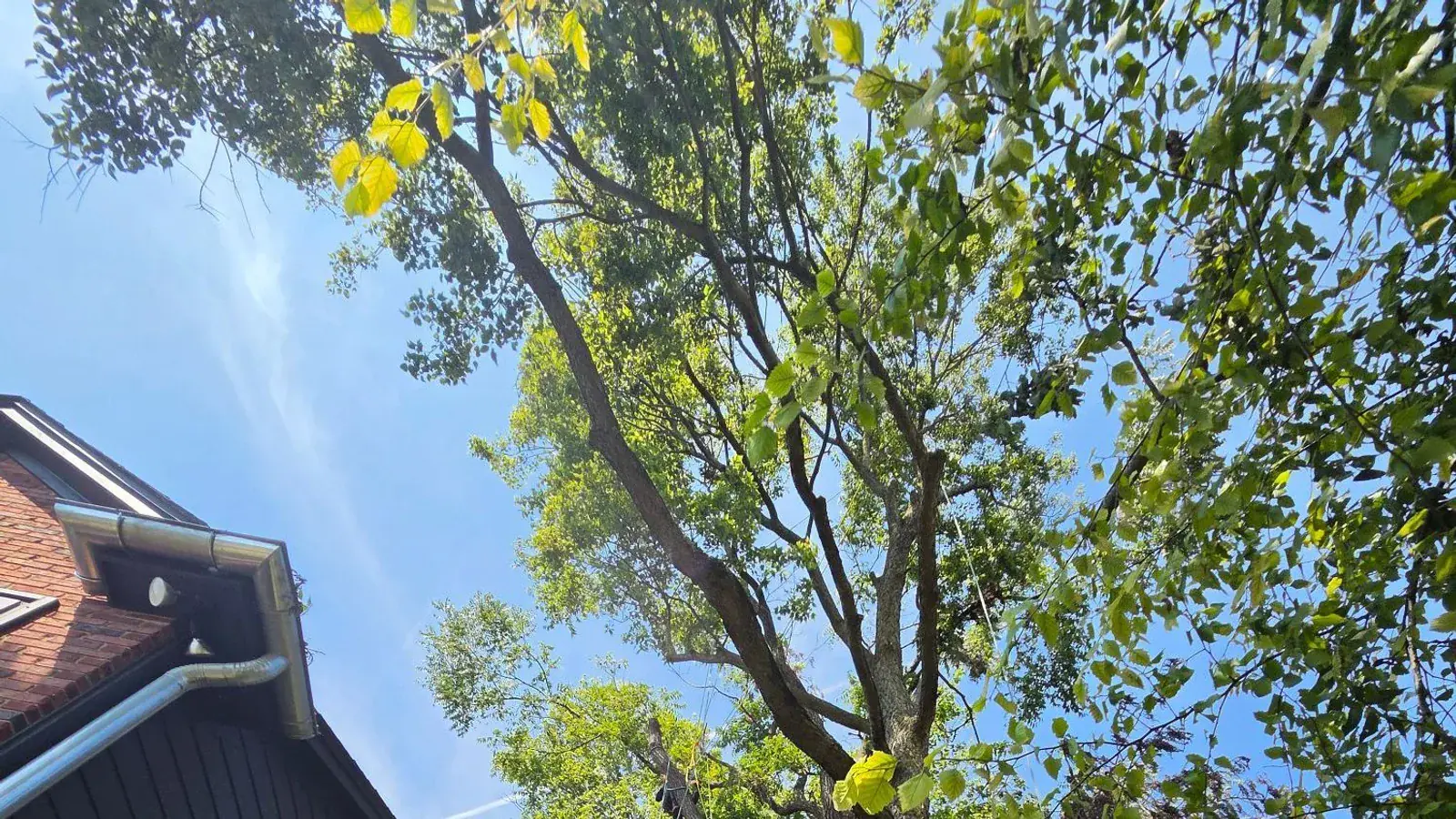
People tend to think about trimming trees when they're looking at the tree — which is summer, when it's full and shading the deck and dropping things on the car. But the best time to prune most trees is when nobody's thinking about them. Here's the calendar we work to in central Indiana, and why.
Late winter — February and March — is the main pruning season for almost every deciduous tree. The tree is dormant, so it isn't losing sap or energy to the cuts; there are no leaves, so we can see the structure and make the right cuts instead of guessing; the wounds seal quickly once growth starts in April; and the insects and fungal spores that get into fresh cuts aren't active yet. Maples, oaks, ash, honey locust, sycamore, elm, hackberry, and most ornamentals: this is their window.
Oaks are the one hard rule. Oak wilt is a fungal disease that kills red oaks in a single season, and it's spread by beetles attracted to fresh wounds. The beetles fly from roughly April through July. So oaks get pruned between November and March, full stop. If a storm breaks an oak limb in June, we clean the wound and seal it, which is the one time you'll see us paint a cut — but we don't do elective pruning on oaks in that window, and you shouldn't let anyone else do it either.
Maples and birches will bleed sap from late-winter cuts once the sap starts to rise in March. It looks alarming and it isn't harmful — the tree is fine — but if it bothers you, maples can be pruned in early winter or after they've fully leafed out in June.
Spring-flowering trees and shrubs — lilac, forsythia, redbud, crabapple, magnolia, serviceberry, viburnum — set next year's flower buds on this year's growth. Prune them in late winter and you cut off the flowers. They get pruned right after they finish blooming, in May or June, which gives them the rest of the summer to set buds again.
Summer-flowering shrubs — the panicle hydrangeas, spirea, rose of Sharon, butterfly bush — flower on new growth, so they can be cut back hard in late winter and will bloom on what grows afterward. Hedges like boxwood, privet and yew get sheared after the first flush of growth hardens off in June, and again in late summer if they need it. Never shear evergreens hard into old wood; most won't grow back from it.
Fruit trees get pruned in late winter for structure and yield, before the buds swell. Apples and pears can take a fairly hard pruning; stone fruits like cherry and peach prefer a lighter touch and, in a wet spring, a slightly later one so the cuts dry quickly.
What can be done any time: dead, broken and hazardous limbs, clearance from a roof, a line or a driveway, and storm damage. A dead limb doesn't care what month it is, and neither does the roof it's about to land on. If it's a safety issue, we do it when you call.
What shouldn't be done at all: topping. Cutting the top out of a tree to make it shorter is the worst thing that can be done to it — it starves the tree, the stubs rot, and the water sprouts that shoot up from them are weakly attached and become the next hazard. If a tree is too tall for where it is, the answer is a proper reduction, or a different tree.
Not sure when your trees should be done? Call Lorenzo's Tree Services at (317) 353-7590. We'll tell you what's on the property and when each one should be booked — and we'll put the oaks on the winter list.